Fine hair is not just thinner. It's a fundamentally different canvas.
And if you treat it like coarse hair — same developer strength, same timing, same technique — you may not get the right results.
Understanding how fine hair behaves under bleach, and adjusting your approach accordingly, is what separates stylists who consistently deliver beautiful blondes from those who cross their fingers and hope for the best.
This guide is going to walk you through exactly that.
Why Fine Hair Is Different (And Why That Actually Works in Your Favour)
Fine hair typically measures around 50 microns in diameter. Coarse hair can be up to 120. That's not a minor difference — it changes everything about how bleach behaves.
The thinner cortex means less structural mass to absorb chemical action.
The reduced natural lipid protection means the hair has less built-in defence.
And the smaller diameter means bleach penetrates faster and more completely than it would on thick, coarse strands.
And of course, if you are trying to take hair blonde, fast lift isn't bad news.
You can use lower developer strength and you get results quicker.
On top of that, fine hair is very often naturally lighter to begin with — typically sitting at level 6 or above.
That means you're starting closer to your goal.
And this in turn means that you can achieve beautiful results with leven ower developer strength and shorter processing times.
The key, however, is knowing how to adapt the products you use and your bleaching technique.
The Risks When You Bleach
Risk No. 1: Breakage
Risk No 1 is hair breakage when you bleach fine hair.
Less structural mass means less tolerance for over-processing.
And over-processing can lead to hair breaking and split ends.
Fine hair that has been previously bleached is particularly vulnerable.
Especially mid-lengths and ends.
The ends and mid-lengths, if they have already been bleached once, should be treated with care.
If any part of the hair has already been bleached in the past, and is bright yellow level 9 or lighter, you should not be bleaching that part again.
Instead, you should stop the bleaching at that part.
If by chance you do apply bleach on any section by mistake, however, don't despair.
Just wipe back with a damp cloth and you will be fine.
You will be able to take care of that section and indeed all sections when you tone.
Ugly Duckling has a range of toners, some with lift and some without.
So you can apply a suitable toner to those parts to equalize and make everything toned and consistent.
Risk No 2: Scalp Sensitivity
Risk no 2 is an itchy scalp.
Fine hair provides less insulation between the bleach and the scalp.
A developer strength that would feel completely comfortable on a client with thick hair can cause burning, tingling, or irritation on finer strands.
This matters especially during root applications, where product sits closest to the skin.
In general, for fine, thin hair, you need to bring down your developer strength in your bleach mix to 20 Vol developer.
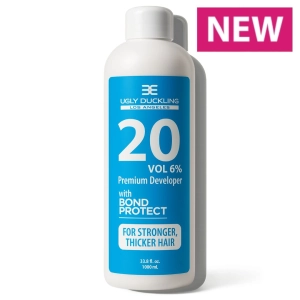
We also recommend that you use our 20 Vol Premium Developer with Bond Protect.
Even so, take care when you apply bleach to the root area.
Apply to the hair, not to the scalp. Stay 1/8 inch away from the scalp itself.
Don't worry, the mixture will travel all the way up.
And with the heat from the scalp and fine hair, you will get your bleach to work and lift very well.
Risk No. 3: Thinning Hair
Risk no. 3 is that repeated bleaching without proper bond protection causes ongoing structural damage that compounds over time.
So, forget any advice you may have received from other stylists that "bleaching is a process, which may involve several trips to the stylist."
No it isn't.
Repeated bleaches just end up making the hair thinner.
Clients with fine hair are often acutely aware of this — they've noticed their hair thinning, they're worried about it, and they need to feel genuinely reassured.
What's more, the ends are always thinner, in any case.
Those parts have been subjected to more repeated colorings, bleaching and blowdrying than any other part. Plus they're physically older.
The ends of the hair could be 2 years old, for instance.
In general, as we said above, you should avoid bleaching any part of your client's hair twice.
And if its the ends, then really don't bleach that part would be our advice.
Otherwise you could end up with more thinning and possibly breakage.
Bleach the parts that need it would would be our suggestion.
And do it once and do it right so that you do not have to subject hair to repeated bleaching.
Which Bleach Should You Use? Which Developer?
The actual bleach that you use makes a huge difference. It's probably the single biggest decision as a stylist that you need to make.
Too often we hear of stylists using indifferent quality of bleach.
Not all bleaches are created equal.
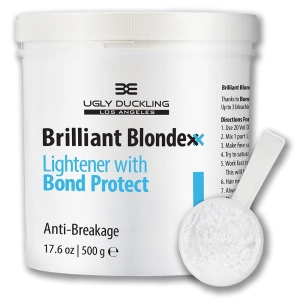
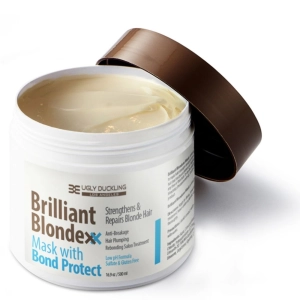
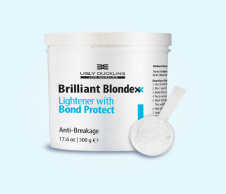
If your client has thin hair, or fragile hair, we recommend that you use Brilliant Blondexx with Bond Protect.
You will get better protection both on the hair and on the scalp if you do that.
And use it with 20 Vol Developer with Bond Protect.
Some Principles That Make the Difference
In addition to using the right bleach and the right developer strength, follow some simple principles here:
1. Make your mix wet.
A thinner, wetter consistency — roughly 1 part bleach to 2 parts developer — spreads evenly and coats each fine strand fully.
A wet mix penetrates well and lifts evenly.
A thick, paste-like mix sits on top of the hair and processes unevenly.
On fine hair, uneven processing is where problems start.
2. Don't apply to areas that have been bleached in the past.
As we said earlier, you need to not bleach parts of the hair (ends especially) if they have been bleached in the past.
Those are the parts that are susceptible to breakage.
3. Watch the hair color and check frequently
Fine hair lifts faster. But that doesn't mean you use a clock.
As all good stylists do, use your eyes. And sometimes your fingers.
As the hair reaches pale yellow, peel back some mix from a section and check exactly how light it is.
Use your fingers to make sure that the hair is maintaining its structural integrity and feels strong to the touch.
Keep checking at different parts: root lengths, ends every 5 minutes after that.
The goal is to rinse at the moment the hair reaches your target level — not to wait and see if you can squeeze out a little more lift.
4. Use Bond Protect After Bleaching & Toning
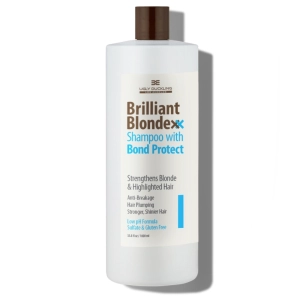
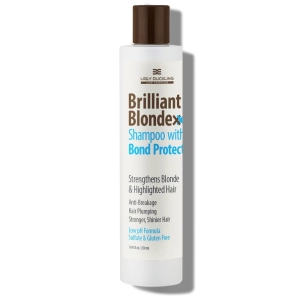
Ugly Duckling's Bond Protect Shampoo & Mask is specifically formulated to close the cuticle and rebuild bond strength between visits.
Use these products straight after bleaching and toning you will notice the difference. The hair will be thicker and stronger.
Which is quite a feat if your client has fine, thin hair.
Technique One: How to do Bleach Root Touch-Up Applications on Fine Hair
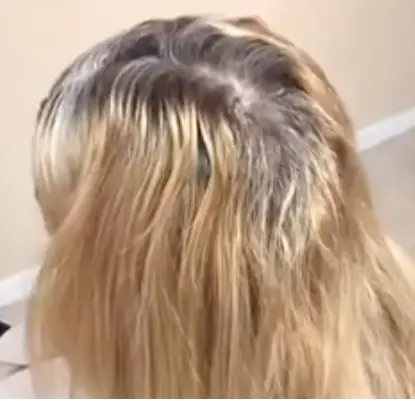
Doing bleach applications on the root area are totally possible with fine hair. Just don't extend onto the lengths.
Root touch-ups are the service fine-haired clients come back for again and again — which means getting it right, every time, matters enormously.
The challenge here is that regrowth at the scalp is naturally warmer and darker than the lightened lengths, and the scalp's proximity means heat builds up faster.
That accelerates lift at the root — which sounds helpful, but also increases the risk of irritation and uneven processing.
The approach:
Apply Brilliant Blondexx mixed with 20 Vol Developer with Bond Protect directly to the regrowth only. Be precise.
The goal is clean, consistent lift at the root without overlapping onto already-lightened hair — because those lengths don't need it, and they shouldn't get it.
If you accidentally apply bleach to previously lightened sections, wipe it back immediately with a damp cloth. No harm done.
Set your timer. Check at 15 minutes and every 5 minutes thereafter.
Once you hit your target level, rinse thoroughly and follow with a bond-strengthening treatment.
On fine hair, rinsing on time isn't optional — it's the whole game.
Technique Two: Balayage on Fine Hair
.png)
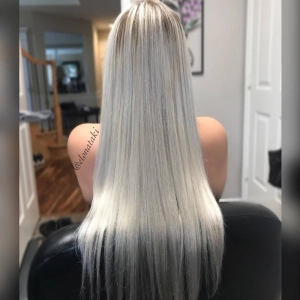
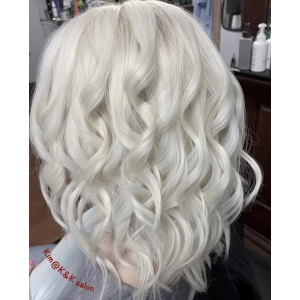
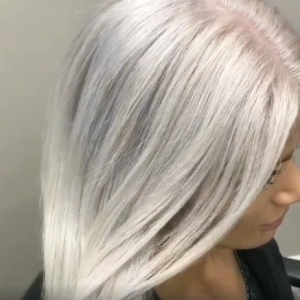
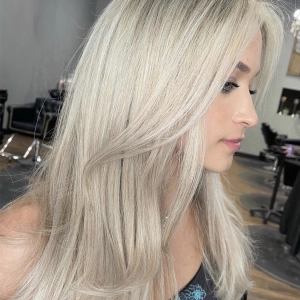
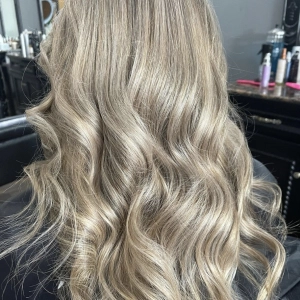
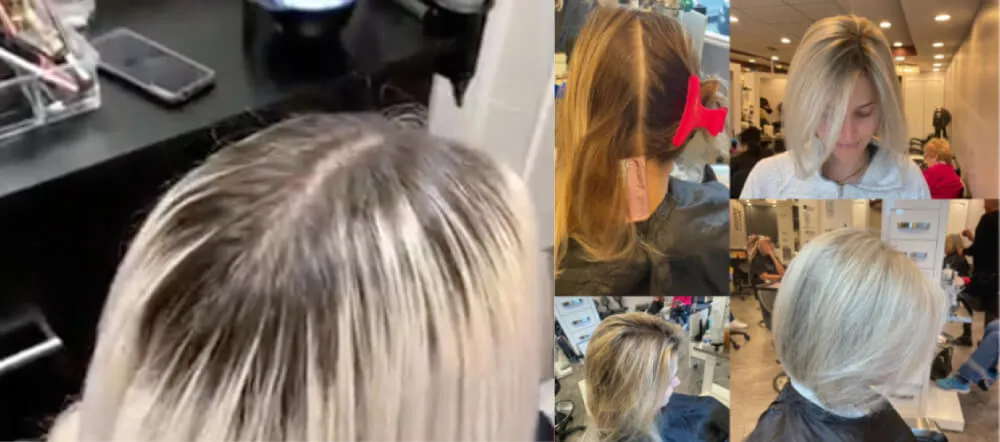
Fine hair that has been perfectly bleached and toned
Balayage on fine hair, done well, is stunning. Done without the right technique and products, it's where the most damage tends to happen.
The reason: you're applying bleach to lengths that may already have some chemical history, working across a larger surface area, and aiming for the kind of lift that creates genuine contrast.
The stakes are higher, the margin for error is slimmer, and the results — when you get it right — are genuinely transformative.
The approach:
For balayage on fine hair, Brilliant Blondexx mixed with 20 Vol Developer with Bond Protect should give you the lift you need on the lengths in the majority of cases.
It should get you 3-4 levels of lift.
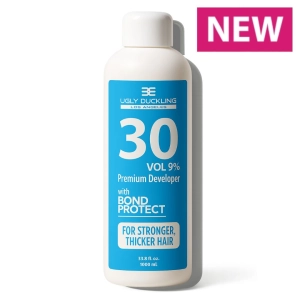
If your client's hair has been colored down for some reason, however, or is really dark despite being fine, then 30 Vol Developer with Bond Protect can be your choice.
It can give you greater lift (up to 8).
Apply in soft, sweeping sections — balayage technique by nature creates a gradient, which works beautifully with fine hair.
Avoid the root area; the lightest results should sit mid-length and at the ends, where they'll catch the light most effectively.
Because fine hair lifts so quickly, the pieces you apply bleach to first will be furthest along by the time you finish your last section.
Work methodically, keep track of your timing per section, and begin checking your earliest applications first.
Rinse sections as they reach the desired level rather than waiting for the whole head to be done if processing times are staggered.
This level of attention is exactly what separates good balayage on fine hair from great balayage on fine hair.
Finish the service with Ugly Duckling Bond Protect Shampoo and Mask and send your client home with the full aftercare routine.
Fine bleached hair needs consistent maintenance between appointments — and setting your clients up with the right products is part of delivering the full result.
Toning
After the bleaching process you are going to need to tone the hair. Ugly Duckling has a variety of toners that do pretty much everything.
A couple of toners that you should consider are:
Toners with Extra Lift
Use Intense Pearl Blonde 100V and Intense Silver Blonde 100B if your bleaching was not 100% successful in getting hair to level 10 and you want to lift and tone some more.
Toners with Regular Lift.
Use Pearl Blonde 10V and Silver Blonde 10B for most cases. These toners contain some lift and will push yellow hair to level 10.
Ammonia-Free Toners
Use Blondify Ammonia-Free toners if the hair is really fine and has been really well lifted already and you want to do a lighter, quicker toning.
Natural Ash Blonde 010A and Natural Violet Blonde 010V should be your go-to toners here.